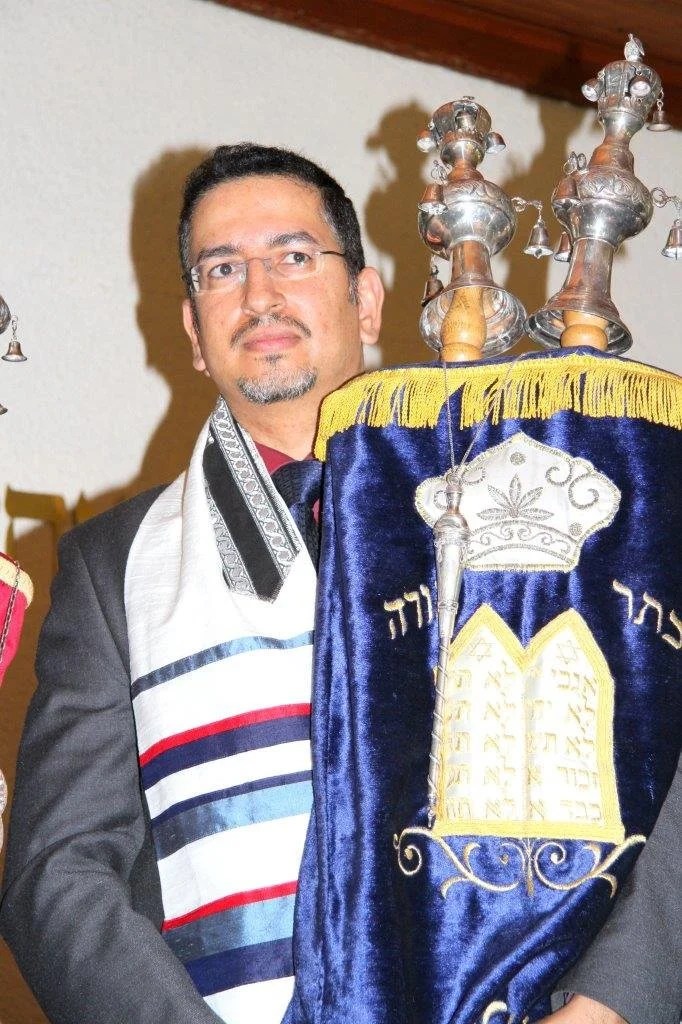
Rabbi Schell’s Dvar Torah in this week’s Jewish Report: http://www.sajr.co.za/docs/default-source/pdf/13-march-2015.pdf
Category: Rabbinic Thoughts
-
Torah Comment – Parashat Vayakehl Pekudei
-
Radio Sermon – Parashat Vayakhel-Pekudei
 If you have missed the last “Devotion” by Rabbi Schell at Radio Today, or if you like to hear it again, you may find the Podcast here:http://betdavid.podomatic.com/ent…/2015-03-11T02_34_28-07_00The D’var Torah is focusing on the Jewish Temple, it’s Progressive Jewish conception and why Jerusalem has an important role for all Jews.
-
Radio Sermon – Parashat KiTisah
If you have missed the last “Devotion” by Rabbi Schell at Radio Today, or if you like to hear it again, you may find the Podcast here: http://betdavid.podomatic.com/entry/2015-03-05T23_55_41-08_00the sermon focus on the lesson we can derrive from the Golden Calf story in the Torah. -
To behold the graciousness of the Eternal
 אחת שאלתי מאת־יהוה אותה אבקש שבתי בבית־יהוה כל־ימי חיי לחזות בנעם־יהוה ולבקר בהיכלו׃One thing I ask from the Eternal, One thing I desire:That I may dwell in the house of Adonai all the days of my life,To behold the graciousness of the Eternal,And to enter His sanctuary.Psalm 27.4Rabbi Avidan, Rabbi Margolis, Rabbi Shaked,Dear congregants and guests,Please allow me to go back for a moment to our Torah reading from yesterday:During Jethro’s visit to the Israelites camp, he notices a long line of people waiting to bring their disputes before Moses. Sitting alone from morning until evening, Moses listens to each argument, hears each problem, and states his judgment on each situation brought before him.Jethro is astounded:“What is this thing you are doing for the people?” he asks Moses.“Why do you act alone, while all the people stand about you from morning until evening?”Noting that Jethro was deeply upset with Moses, Rabbi Fields quotes an ancient sage who suggests that what disturbed Jethro was not Moses appeared overworked – but that Moses had become full of self-importance. Moses, he says, was “behaving like a king, who sits on his throne while all the people stand.”The Torah is – as I have mentioned several times before – an important guideline for every one of us. One of its goals, to my understanding, is to form a just society. The Torah forms out of a group of slaves a nation of priests, serving God and all humanity. There is a massage for every one of us, as we are all to some degree slaves to something, and we will hopefully become once all these cohanim, priests, the Torah envisions us to be.And so it doesn’t come as a surprise that the Torah is raising the question of leadership several times. As much as the Torah leads us to a society founded on the ideal of equality and democracy, it does not undermine the need of a strong leadership, as long as it is to the benefit of the people. And that is why Jethro criticizes Moses so harshly right in the beginning of his leadership.The quote for our induction from the 4th book of Moses, Numbers 27.16 and 17 underlines this idea. This time it is Moses, who asks God at the end of his leadership to appoint a new leader, a good shepherd for the Israelites “who shall go out before them and to come in before them”.“Both instructions of the Torah teach us that leadership has always been a serious responsibility. Caring for the safety of a community and preserving its culture and traditions are complex tasks. Jethro appreciated the need to share the burden, and the interpreters of his advice to Moses – defined for us the qualities of leadership – required by Jewish tradition.” (Fields)And so I pray to God, as we both, Rabbi Margolis and I, are entering the leadership of this community that we will meet the standards our tradition has set for us, that we will be wise in our leadership like the old Moses, and always sensible to the need of our people, you all, like Jethro.And let us say Amen.Source: Fields, Torah Comment
-
Shabbat Shekalim
Shabbat Shekalim (“Sabbath [of] shekels”) takes place on the Shabbat before the 1st of the Hebrew calendar month of Adar, and is one of the four 4 special Shabbatot surrounding Purim and Passover to help us prepare physically and spiritually for those holidays. Traditionally every adult Jew was requested to contribute a half of a Biblical shekel for the upkeep of the Tabernacle. This tax was due by the 1st of Nisan, meaning in a month from now. In later times – as we can understand it from our Haftarah – the donation was used for maintenance of the temple. Today we can understand it as a contribution to the infrastructure of a community. The building and maintenance of a Synagogue for example. As the Israelites contributed to the building of the Mishkan, the tabernacle, we are still today asked to support our communities.But we shouldn’t make the mistake to understand it only as a donation of money. This is one way of support, but Silver and Gold are only placeholder/symbols for other things we can give. It can be a cake for a Bracha, help when something needs to be prepared or done in the Synagogue or the visit of people who are sick. Sometimes, “just coming to the prayer services” can be a big contribution. Today, I think, the giving of TIME is one of the most valuable offerings we can give to our community.Thank you all. – Rabbi Adrian M Schell
-
Parashat Mishpatim and Shabbat Shekalim
Torah Comment Parashat MishpatimExodus 21:1 – 24:18 (Reading Ex. 23:26–24:18 Plaut p.522; Hertz p.319)Haftarah Shabbat Shekalim 2 Kings 12:5-16 (Plaut p.1451; Hertz p.993)After last weeks Revelation at Sinai, and the giving of the Ten Commandments, after the thunder and lightning and the mountain covered in a cloud of smoke—what could possibly come next? Indeed what could follow that spectacular event? This week’s Torah portion talks about rules and regulations: ordinary everyday rules, about how to live in a society. Moses details many of God’s laws to the Israelites. These include laws about worshiping other gods, kashrut, business ethics, as well as the treatment of animals. God outlines the details of three holidays: Passover, Shavuot, and Sukkot. Moses goes up to Mount Sinai to meet with God for 40 days and 40 nights, leaving Aaron and Hur in charge.I think it is interesting to note that the traditional division of the texts into weekly portions splits this covenantal material into two parts, with the matters relating to belief and religious cult attached to the end of the last week portion Yitro. And on the other hand we learn about more mundane matters of relationships between people in this weekly section of Mishpatim. In order to have a meaningful society we have to have a social order. Some laws from this weekly portion have been kept until our days. Every modern society should feel obliged by the core idea of the Torah, and it has to be interested in equality, justice, and welcoming a stranger into our midst.-Rabbi Julia MargolisShabbat ShekalimShabbat Shekalim (“Sabbath [of] shekels”) takes place on the Shabbat before the 1st of the Hebrew calendar month of Adar, and is one of the four 4 special Shabbatot surrounding Purim and Passover to help us prepare physically and spiritually for those holidays. Traditionally every adult Jew was requested to contribute a half of a Biblical shekel for the upkeep of the Tabernacle. This tax was due by the 1st of Nisan, meaning in a month from now. In later times – as we can understand it from our Haftarah – the donation was used for maintenance of the temple. Today we can understand it as a contribution to the infrastructure of a community. The building and maintenance of a Synagogue for example. As the Israelites contributed to the building of the Mishkan, the tabernacle, we are still today asked to support our communities.But we shouldn’t make the mistake to understand it only as a donation of money. This is one way of support, but Silver and Gold are only placeholder/symbols for other things we can give. It can be a cake for a Bracha, help when something needs to be prepared or done in the Synagogue or the visit of people who are sick. Sometimes, “just coming to the prayer services” can be a big contribution. Today, I think, the giving of TIME is one of the most valuable offerings we can give to our community.Thank you all. – Rabbi Adrian M Schell
-
Torah Comment – Parashat Bo
In Parashat “Bo”(Go) Moses and Aaron continue to plead with Pharaoh to let the Israelites go free. Because Pharoah refuses, God is is co-erced into raining down the last plagues onto the Egyptians: the plague of locusts, darkness, and finally, the death of their firstborn. At midnight on the night of the last plague, Moses leads the Israelites out of Egypt and proclaims that each year on the evening of the 14th day of the first month a festival lasting seven days – called Pesach – will be celebrated in order to recall the Israelites liberation from Egypt. (In this year Erev Pessach falls on 03 April.) (more…)
-
Parashat Va’era Torah comment
In parashat Va’era („And I appeared“) we learn more about the relationship between God and the Jewish people and about the promise to give the Land of Israel to the people. God tells Moses that the time has come to free the Israelites from Egyptian bondage. As Moses feels that he is not the right person to represent the Jewish people, God appoints Moses bother Aaron to accompany him as the spokesperson. The two brothers appear before Pharaoh to request the freedom of the Israelites, but Pharaoh refuses to liberate them. As a consequence, “the” 10 plagues are set up upon Egypt.Our Torah portion presents us with a difficult question in this and next weeks portion: The Torah mentions twenty times the “hardening” of Pharaoh’s heart as an reaction on Moses and Aarons request to free the Israelites. The first ten have to do with the first five plagues, and in each we are told that “Pharaoh hardened his heart,” while the next ten times – in reference to the next five plagues – the text tells us that “God hardened Pharaoh’s heart.” (more…)
-
Parashat Sh’mot
A few weeks ago, the film Exodus – Kings and Gods was launched and, in anticipation of the upcoming Torah readings about the liberation of the Israelites from slavery, I decided to watch the movie. I wanted to see how the authors of the film interpreted the biblical narrative. I was disappointed in the film in so many ways. I never expected to see a movie that was close to the bible’s narrative, and/or to Jewish interpretation, but in my opinion the film’s only goal was to devalue the Bible. The filmmakers presented a crude idea of a shizophrenic Moses who caused Israel to become insane followers of a cruel, child-murdering God.This film is not the first attempt at finding scientific explanations for the 10 plagues, and to devalue Moses’ prophecy as a kind of mental delusion. Usually, I don’t mind these attempts, as long as they respect and don’t vilify those who have a different understanding of the Torah. Unfortuantely this film has no intention of doing so. (more…)