I was moved, and proud, when our cheder students stepped up last Shabbat to share readings and testimonies at our Remembrance Shabbat. Knowing that the next generation is taking on the responsibility of remembering makes me hopeful that, indeed, the future is in good hands. Remembrance Shabbat often marks, as it does this year, the beginning of Interfaith Week.
While writing this, I have just returned from an encounter with Bishop Martin, the Bishop of Kingston, whose portfolio in the Diocese of Southwark includes interfaith relations. We spoke about honest dialogue, and about how political trends over the past year have made some of our conversations very difficult. Perhaps struggle is part of our relationship with our closest siblings.
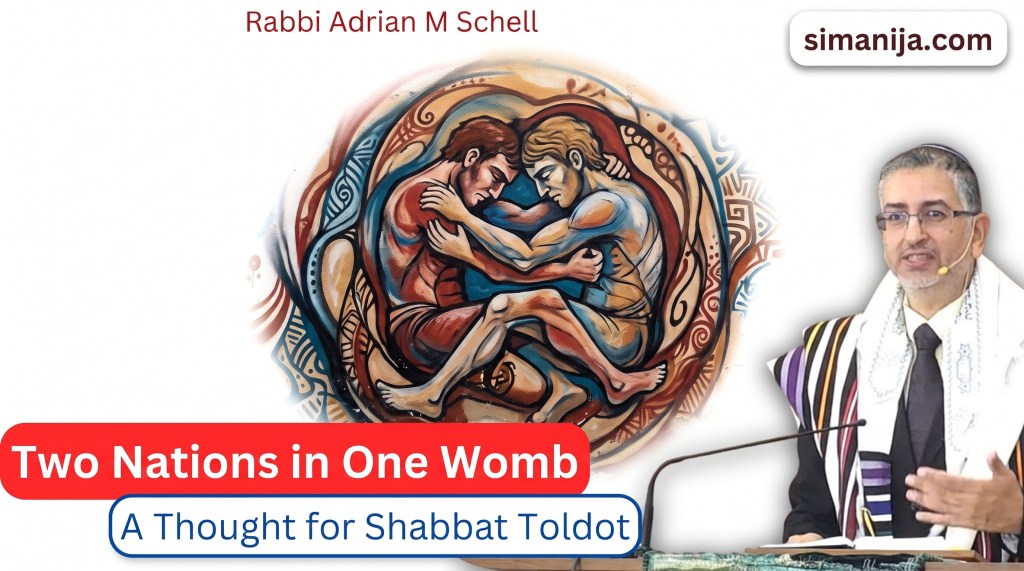
“Two nations are in your womb” (Genesis 25:23)
This week’s portion, Toldot, is perhaps the earliest picture of such a relationship. While Rebekah is pregnant, the twins struggle inside her so fiercely that she cries out in distress. God answers her: “Two nations are in your womb” (Genesis 25:23). Two peoples, already pulling in different directions before a single breath is drawn. Our tradition read Jacob and Esau as more than two brothers: later Israel and Edom, and in time, Jews and Christians. From before birth, the Torah tells us, this is a relationship of closeness and struggle, and it does not hide it. The rivalry does not fade as they grow. From a stolen birthright to a stolen blessing, the brothers compete for years, until one flees and the other stays, and they live apart with a wound between them.
But next week’s portion, Vayishlach, brings the reunion. Esau runs towards Jacob, embraces him and kisses him (Genesis 33:4). In the Torah scroll, dots stand over the word vayishakehu, “and he kissed him”. Rashi tells us that some of our sages read it as a kiss with all his heart, and others as something closer to a bite. The tradition could not decide, and I find that rather honest. We know what this feels like: to hope for a kiss and to brace for a bite.
This week of Remembrance and Interfaith Week asks both of us. Zakhor, remember. We do not forget what was done to us, and we teach our children not to forget. And yet the Torah also says: “You shall not abhor an Edomite, for he is your brother” (Deuteronomy 23:8). Remember, but do not hate. I will not pretend that this is easy. Memory that turns into hatred poisons the one who carries it. Memory that stays open can become the place where brothers meet.
That is the stubbornness I want to name this Shabbat: to remember everything, and still to hope.
May we remember truthfully. May we hope stubbornly. And may we keep walking towards our brothers and sisters, even when the road is hard.
Shabbat Shalom
Rabbi Adrian

