Author: Rabbi Schell

  • The Weight of Witnessing: Why Your Heart Feels Heavy for Others

    The Weight of Witnessing: Why Your Heart Feels Heavy for Others

    What happens to you when someone close to you is hurting? When you sit by a loved one who cannot get out of bed, or when you hear, again and again, the news from Israel, Gaza, and the Ukraine, and feel it in your body, even though you are far away? Those moments can leave you anxious, tired, unsettled, and you may wonder if you are even “allowed” to feel this way when you are not the one at the centre of the crisis. 

    Looking at the 10 plagues at the beginning of the Exodus narrative, I think they not only strike Egypt but also pass through the Israelite houses as sound, fear, and memory. The Israelites may be spared some of the blows, but they still live with the cries in the night and the knowledge of what is happening next door. Their identity is shaped not only by their own suffering, but by what they have witnessed in others. 

    Most of us are more often witnesses than protagonists. We watch someone we love in the grip of depression, anxiety, psychosis or burnout. We see their “plague of darkness” from the edge of the room: the closed curtains, the empty chair in shul, the unanswered messages. We might not be the ones in crisis, yet the experience marks us. Sleep changes. Worry grows. The world feels less stable, less kind.

    Psychologists call this secondary trauma (1): the impact on those who live close to pain, who listen to stories and hold fear without being able to make it go away. That impact is real. It is not self-indulgent to feel shaken when a friend is suicidal, or when the news from Israel and Gaza leaves you nauseous and tense. Feeling affected does not mean you are centring yourself; it simply means your heart is working.

    Perhaps the inner question is this: when you see someone struggling, what happens in you? Do you tighten, go numb, change the subject, because it feels too much? Or do you allow a small crack to open, enough to say: “This is hard for you. I am here. This is also hard for me to see, and I will not look away.” Both kinds of truth can sit in the same conversation.

    If you are living beside someone’s anguish, your own feelings count. You are not required to be endlessly strong or endlessly calm. You are allowed to seek support, to say to a friend or a professional, “Being near this suffering is taking a toll on me.” That honesty does not diminish your compassion; it protects it.

    Perhaps the blessing we can  offer one another this Shabbat is simple and demanding: that no one should have  to endure their own darkness alone, and that no one should have to carry,  unacknowledged, the weight of standing at the doorway, listening.

    Shabbat Shalom.

    Rabbi Adrian M. Schell

    [1] Sources: https://pmc.ncbi.nlm.nih.gov/articles/PMC4747238/
    https://www.tendacademy.ca/signs-and-symptoms-of-compassion-fatigue-and-vicarious-trauma/
    https://core.ac.uk/download/pdf/39664632.pdf

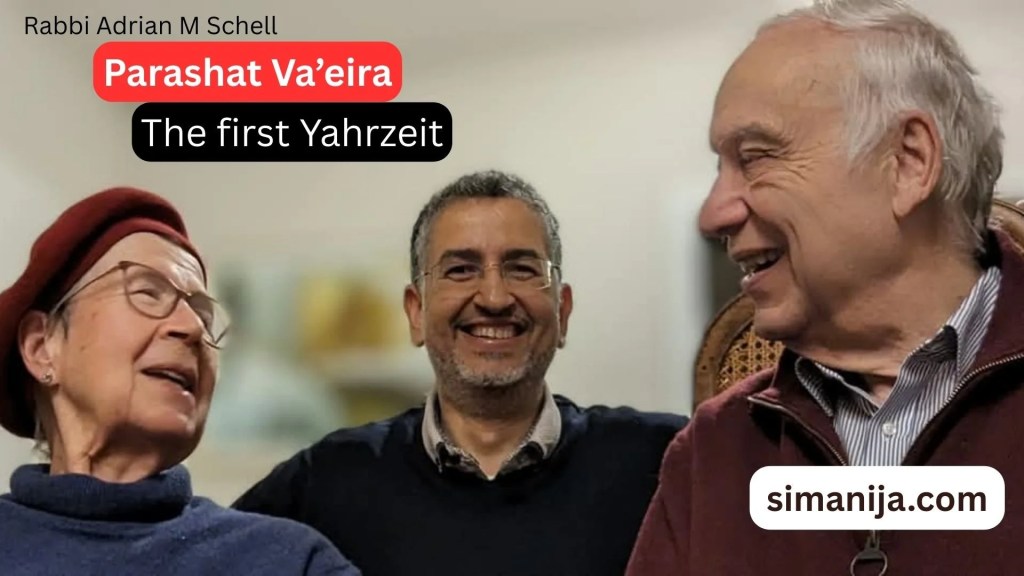
  • A Letter to Myself: Reflections on my father’s first Yahrzeit

    A Letter to Myself: Reflections on my father’s first Yahrzeit

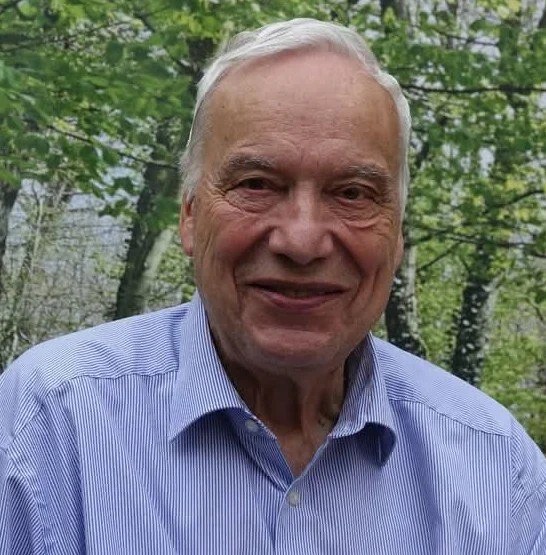
      Michael Schell z’’l 1939-2025
    Michael Schell z’’l 1939-2025

    Last month, I received a letter from the synagogue office.

    It contained words I had written two or three years ago, but it was the first time I received this letter addressed to myself. The letter told me that a full cycle of the seasons has passed since my father died.

    In our tradition, the first yahrzeit is a significant threshold. It marks the end of the formal period of mourning and the transition into a lifetime of memory. As I stand before you, I find myself looking back at a year that was unexpectedly crowded with the presence of death.

    In the twelve months since my father’s passing, our community has accompanied around twenty individuals on their final journeys.

    For a rabbi, the task of walking with the bereaved is a constant, but this year, the weight of it felt different. There was a strange, heavy resonance between my private study, where I sat with my own grief and the living rooms where I sat with yours. Yet, in a way that I am still trying to fully understand, this year of intense communal loss felt, if not easier, then more grounded than the years that came before.

    There is a profound theological clue to this experience in the opening verses of our Parashat Va’era. As God prepares Moses for the monumental task of liberation, the text records a shift in the Divine perspective. God says, “I have also heard the moaning of the Israelites, whom the Egyptians are holding in bondage, and I have remembered My covenant” (Exodus 6:5).

    Note the sequence of the verbs. In earlier chapters, we are told that God “knew” of the suffering. But here, the Torah emphasises that God “heard.” There is a radical difference between knowing a fact and hearing a soul.

    To know someone is suffering is an intellectual or observational state; to hear their groaning is to be pulled into their reality. In the Jewish tradition, hearing is the first step toward redemption. It is the theology of “Bearing Witness.”

    Before I lost my father, I “knew” what bereavement looked like. I had the liturgy, the psychological frameworks, and the professional experience to offer comfort. But this year, I started to “hear.”

     My own loss acted as a sort of spiritual tuning fork. When I sat with a family this year, I was no longer just a narrator of the tradition. I was a fellow traveller.

    I found that the act of truly listening to your stories—how your husband laughed, how your mother struggled, how your friends left gaps in your lives—became the very mechanism through which I processed my own father’s death.

    There is a beautiful reciprocity in the act of bearing witness. As a chaplain and rabbi, I have always taught that being heard is the first step in moving from the “slave-state” of being an object of tragedy to the “human-state” of being a subject with a story. This year, I realised that this applies to the listener just as much as the speaker.

    In the noisy, frenetic world we inhabit, the act of truly listening is a godly act. We live in a culture that values “knowing” and “solving.” We want to fix the grief, to offer the right cliché, to find the “scalable” solution to sadness. But Parashat Va’era suggests that God’s first act of redemption was not to “part the sea” or to send the plagues, but simply to listen without interruption.

    The Hebrew word Sh’ma means more than just perceiving sound; it implies a deep, responsive attention. When God “heard” the Israelites, it meant their pain was no longer just a background noise of history; it became a command for action.

    Perhaps this is why the last year felt more manageable for me despite the high number of deaths in our community.

    When we are in the midst of our own mourning, we often feel isolated, as if we are the only ones wandering in the desert. But through the necessity of my role, I was forced to hear your groaning alongside my own. In doing so, the “I” of my grief became a “We.” The burden did not get lighter in terms of its mass, but it became easier to carry because it was distributed across a community of shared experience.

    This is the essence of Jewish life. We do not claim to have easy answers for why we suffer or why the world is often so cruel. Instead, we commit to the radical act of being present for one another. We build a sanctuary not of stones, but of ears and hearts.

     As I reflect on my father’s life and the many lives we have celebrated in this sanctuary over the past year, I am struck by the power of the human voice to break through the silence of the void. We are a people of the word, yes, but we are primarily a people of the ear.

    My challenge to us all as we move into this next year is to cultivate this divine quality of hearing. To bear witness to the person sitting next to you, not by offering advice or trying to “know” their situation, but by simply hearing their “na’akah,” their groaning, and their joy.

    I want to thank all of you for the listening you have done in the past year. For the support and the love.  May we continue to support one another through the shadows, knowing that even in the darkest night, the act of listening is a light that never goes out.

    And for my father, and for the souls we have mourned together this year: may their memories continue to speak to us, and may we always have the merit to truly hear them.

    Zichrono Livracha


  • Exploring Faith and Autonomy

    Exploring Faith and Autonomy

    My Interview on Bordering On Belief

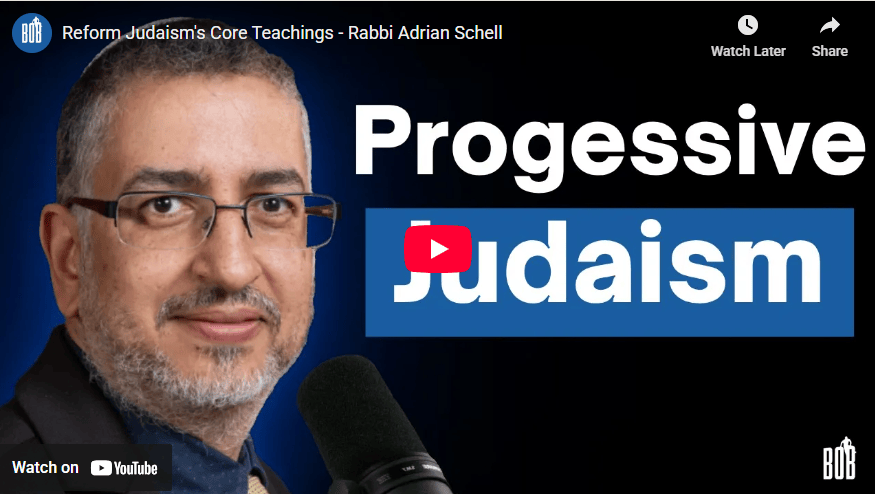
    I recently had the lovely opportunity to sit down for a deep dive into the heart of Reform Judaism with the Bordering On Belief podcast. It was a wonderful opportunity to reflect on the values that guide my work and my faith, particularly the idea of “informed autonomy” (the freedom to make our own spiritual choices based on study and reflection).

    In our conversation, we explored how our tradition remains a living, breathing resource for the modern world. We talked about why I believe revelation is an ongoing journey and how we can approach even the most challenging ancient texts with an open, questioning mind. For me, the most profound moments of faith happen in our connections with other people, and I truly enjoyed sharing that perspective.

    I hope you find the conversation as engaging and thought-provoking as I did.

    Watch the full interview here: https://youtu.be/_xhh4uPn_0U

  • The Courage of Inadequacy

    The Courage of Inadequacy

     Just as you see the Shaked, so I am Shoked
    Just as you see the Shaked, so I am Shoked

    We often imagine the great biblical leaders as individuals of unshakeable confidence. We tend to picture the cinematic version of Moses, standing fearless before Pharaoh, or the booming voice of a prophet thundering against corruption. Yet, when we look closely at the texts appointed for this Shabbat, we find something far more human, fragile, and reassuring.

    In our Torah reading, Exodus 3, Moses stands before the burning bush. He does not immediately volunteer for the task of liberation. On the contrary, he resists. He asks, “Who am I that I should go to Pharaoh?” He is anxious about his standing, his ability to speak, and his worthiness. He looks at the task and feels entirely too small.

    We find an almost identical hesitation in the Haftarah (Jeremiah 1: 1-12). Jeremiah’s career begins with a protest: “Ah, Lord God! I do not know how to speak, for I am only a youth.” Both of these spiritual giants look in the mirror and see only their limitations.

    The profound optimism in these stories is found in the Divine response. It is fascinating that God never contradicts their self-assessment. God does not argue with Moses by saying, “Actually, you are quite a dynamic speaker,” nor does He tell Jeremiah, “You are more mature than you realise.” God does not offer a pep talk about their skills.

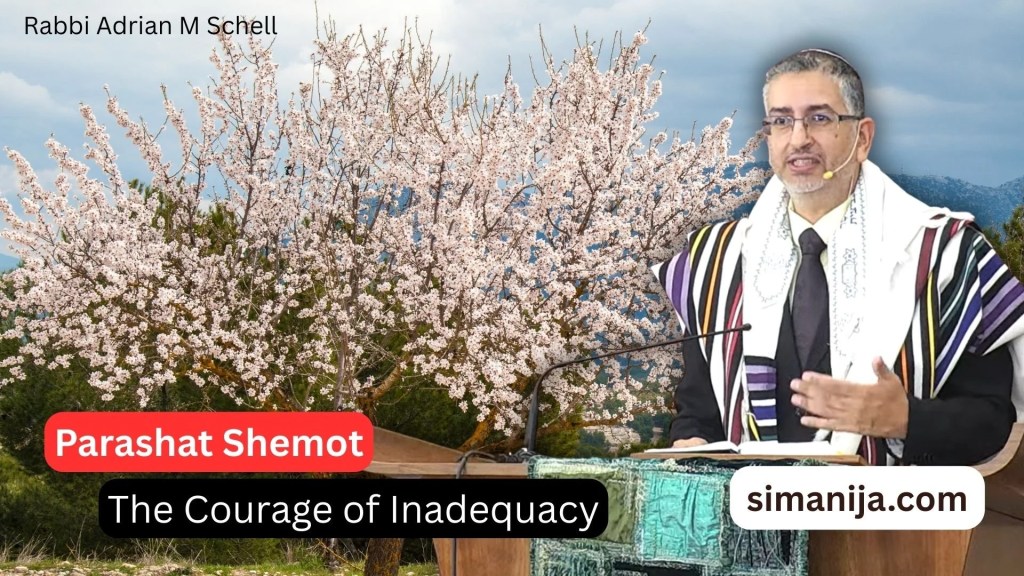
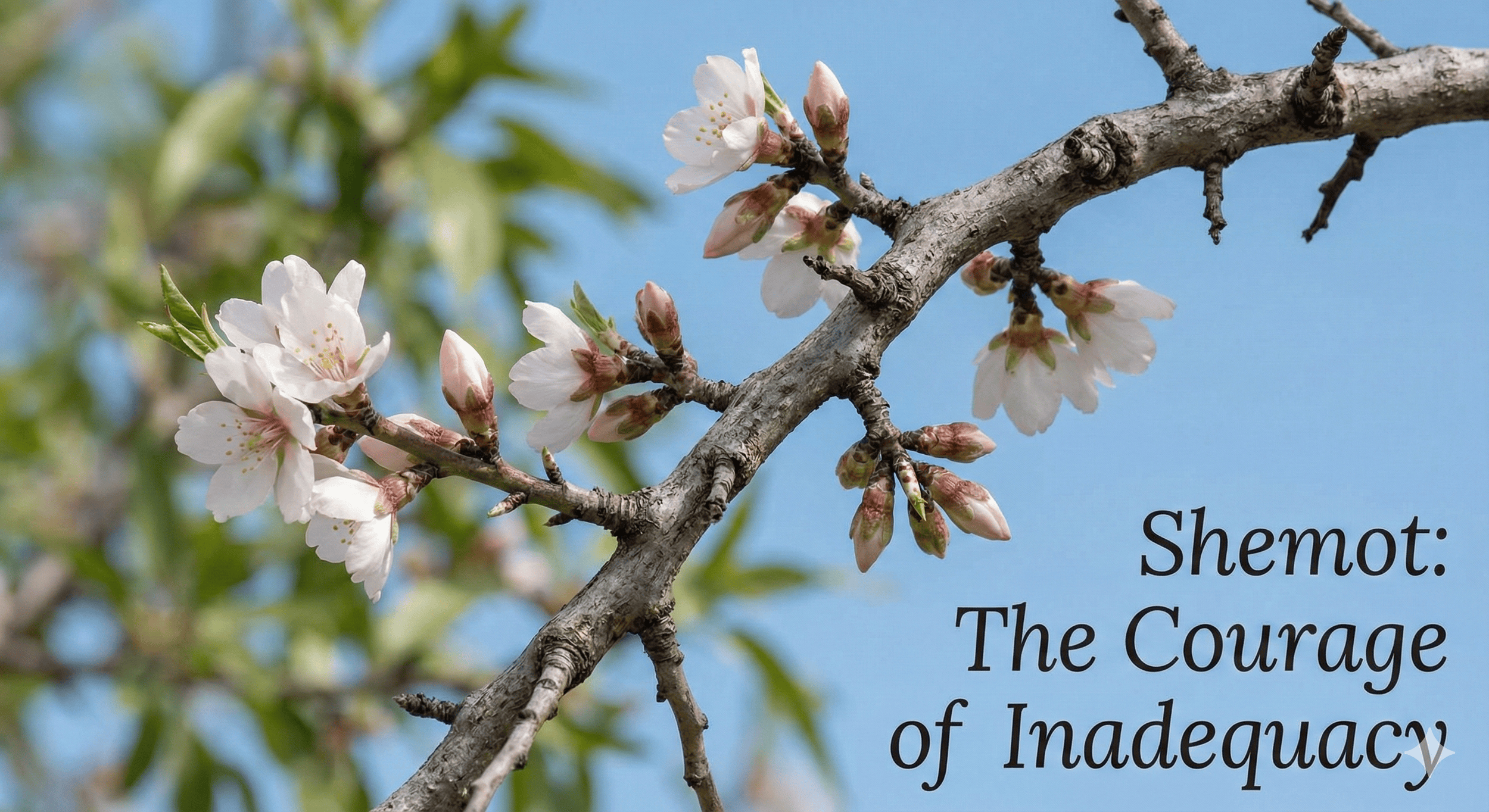
    Instead, God offers a relationship. To Moses, the answer is simply: “I will be with you.” To Jeremiah, God shows a vision of an almond branch, שָׁקֵד shaked in Hebrew, which is the first tree to blossom after winter. It is a symbol that God is “watching” (שֹׁקֵד shoked) and present, ready to make life bloom where it seems impossible.

    The message for us is clear. We often wait until we feel perfectly ready, qualified, or “enough” before we step forward to help our community or challenge the brokenness of our world. We wait for our impostor syndrome to vanish. Our texts remind us that the feeling of inadequacy might never go away, but it does not have to stop us.

    We do not need to be perfect vessels to carry a holy message. We do not need to have all the answers. We only need the willingness to turn aside, notice the bush that burns but is not consumed, and say, “Hineni—Here I am.”

    Shabbat Shalom.

    Rabbi Adrian

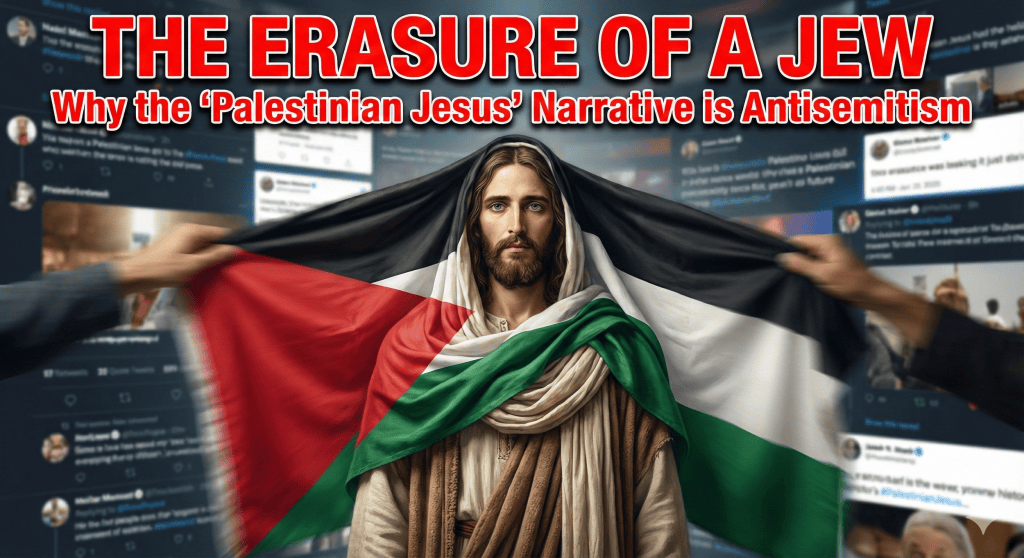
  • The Theft of Memory: Why the “Palestinian Jesus” Narrative is Antisemitism

    The Theft of Memory: Why the “Palestinian Jesus” Narrative is Antisemitism

    Over the recent holiday period, whilst millions gathered to celebrate the birth of a Jewish child in Bethlehem, a different and deeply troubling narrative was being broadcast. From a billboard in New York City to a surge of viral social media posts, the claim that “Jesus was a Palestinian” has been repeated with increasing confidence. To many, this assertion sounds like a gesture of solidarity. To a historian, it is an error. But to a Jew, it is the unmistakable sound of an old enemy returning.

    This is not merely a debate about ancient geography. It is the revival of Supersessionism, or “Replacement Theology”, the ancient and poisonous doctrine which taught that the Church had “superseded” the Jews as God’s chosen people. Today, we are witnessing a secular mutation of this hatred. It is an attempt to sever the Jewish people from their own history and land, rebranding Jesus to fit a modern political script.

    The Mechanism of Erasure

    For centuries, Christian Supersessionism argued that the “Old Israel” (the Jews) was defunct, stubborn, and blind, while the “New Israel” (the Church) had inherited all the blessings. To make this theology work, Jesus had to be extracted from his people. He could not be a Judean loyal to the Torah; he had to be invented in opposition to the “legalistic” Jews.

    The modern claim that Jesus was “Palestinian” operates on the exact same structural logic. It is political supersessionism. Where theological supersessionism said, “The Church replaces Israel as God’s people,” political supersessionism says, “Modern non-Jews replace Jews as the authentic heirs of the land and even of Jewish religious figures.” The structure of erasure is the same. It argues that Jesus is too much of a symbol of Justice and Liberation to belong to the Jews, who are now, once again, cast as the villains of the story. Therefore, he must be stripped of his Jewishness and handed over to the “new” symbol of the oppressed, the Palestinians.

    Whatever the intent, the effect of this slogan is antisemitic: it erases Jewish identity from the most famous Jew in history and replays a long pattern of Christian supersessionism. It is a demand that Jews must commit identity suicide to be accepted in the room of justice. We see this in protest chants and campus discourse where Jewish participants are told they must renounce Zionism or Jewish peoplehood to be acceptable. It implies that one cannot be a Zionist, an Israeli, or a Jew, and still represent universal morality. Therefore, Jesus must be saved from his own kin. He must be rescued. He must be relabeled.

    The Historical Reality: A timeline of dispossession

    We must confront the historical illiteracy required to maintain this narrative. To label Jesus of Nazareth a “Palestinian” is profound historiographical malpractice. It imposes a colonial Roman administrative designation from the second century onto a first-century Judean reality.

    As every serious historian of Jesus acknowledges, and as New Testament scholarship has repeatedly emphasized, Jesus was born, lived, and died a Jew in Judea (Yehud) and Galilee. Mainstream historians such as E.P. Sanders argue explicitly that Jesus was deeply embedded in first-century Judaism. During his lifetime, the land was known as Judea. The term “Syria Palaestina” was not codified as the official political designation for the region until the Emperor Hadrian did so in 135 CE.

    This date matters. Hadrian renamed the land a full century after the crucifixion. He did so as a punitive measure following the Bar Kokhba Revolt, specifically to crush Jewish national sovereignty. He chose the name of the Philistines, the biblical enemies of the Israelites, to humiliate the defeated Jews. To call Jesus a “Palestinian” today is to validate this colonial erasure. It finishes Hadrian’s work by stripping an indigenous man of his identity and clothing him in the name of his conquerors.

    Those who defend this narrative often rely on three specific arguments. Each collapses under scrutiny.

    1. The Geography Myth

    Critics argue that because Jesus lived in the land we now call Palestine, it is just a geographical term. Some repeat this slogan thinking it is a harmless geographical update. But geography is not neutral when it is used to overwrite a people’s historical name for themselves.

    When careful historians speak of “Jewish Palestine,” they are usually naming a region and immediately stressing that its people were Jews. That is very different from modern slogans that strip away the word “Jew” and announce that “Jesus was Palestinian” as if he belonged to a non-Jewish nation opposed to Jews. The first is geographical shorthand. The second is historical revisionism that walks in the footsteps of Rome’s attempt to rename Judea and centuries of Christian supersessionism.

    We do not retroactively rename historical figures based on current maps. Immanuel Kant was born in Königsberg, Prussia. Today, that city is Kaliningrad, Russia. Yet we do not call Kant a “Russian philosopher”. We acknowledge his context. To insist on “Palestinian” for Jesus, whilst ignoring the actual name of the land in his time, reveals that the choice is ideological, not geographical.

    2. The Solidarity Claim

    This argument suggests that because Jesus stands with the suffering, and Palestinians are suffering, he identifies as Palestinian. This relies on a dangerous binary that equates “Jewishness” with “Oppression”. Solidarity does not require a change of ethnicity. When a white civil rights activist marched with Dr Martin Luther King Jr in Selma, they stood in deep, radical solidarity with Black Americans. But they did not become Black. To claim they must change their race to support the cause is to deny their capacity for allyship. Jesus can weep for Gaza as a Jew. To say he must become Palestinian to care is to deny the Jewish capacity for empathy.

    3. Playing Indian

    This narrative claims that if Jesus were born today, he would be a Palestinian because he was “native” to the land. This is a reversal of history. Jesus was an indigenous Judean. If he were alive today, strictly speaking, he would likely be an Israeli Jew. Perhaps he would be a radical critic of the government, perhaps a peacemaker standing at the checkpoints screaming for justice, but he would remain a Jew. To imply that he would abandon his Jewishness to be “moral” is to reinforce the antisemitic trope that Jewishness itself is incompatible with justice.

    The Theft of Memory

    We have walked this road before. In the 1930s, the “Deutsche Christen” in Germany sought to align Christianity with Nazi ideology. They created the fiction of an “Aryan Jesus”, arguing he could not be one of “those people”. To label Jesus a Palestinian today is to walk in those same footsteps.

    This is not liberation; it is theft. It takes the most famous Jewish son in history and tells his family: “He is no longer yours.”

    We can, and we must, have deep compassion for any suffering. My heart breaks for the pain in the region. But we do not need to lie about the past to advocate for the future. We can fight for human rights without colonising history.

    Let us honour the dignity of truth: Jesus was a Jew. Denying that will not save a single life, but it will make peace harder by poisoning the past.

    Sources:

    https://real-phd.mtak.hu/2160/7/disszertacio_DOI_Kiss-Andras_ORZSE.pdf?utm_source=perplexity

    https://religionnews.com/2025/03/11/why-jesus-is-a-palestinian-sounds-like-christian-solidarity-but-is-disastrous-theology/?hl=en-GB-u-fw-sun-mu-celsius

    https://en.wikipedia.org/wiki/Jesus?wprov=sfla1

    https://en.wikipedia.org/wiki/E._P._Sanders?wprov=sfla1

    https://www.scriptureanalysis.com/when-judea-became-palestine-origins-explained/?hl=en-GB

    https://www.rootsmetals.com/blogs/news/jesus-was-judean-why-this-matters?hl=en-GB#:~:text=Jesus%20was%20Judean%20(%26%20why%20this%20matters)%20%E2%80%93%20Roots%20Metals

    https://www.britannica.com/biography/Jesus/Jewish-Palestine-at-the-time-of-Jesus?

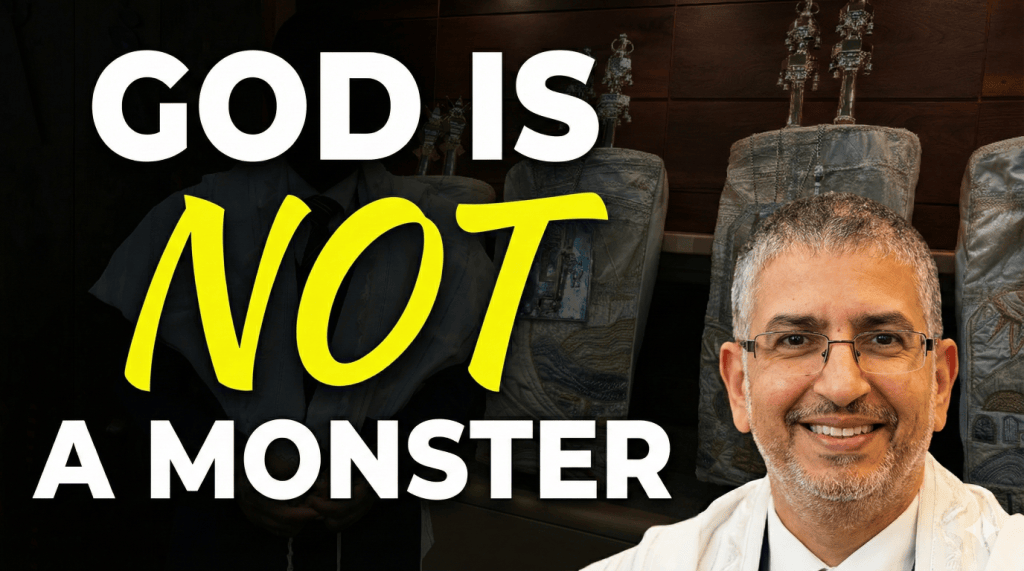
  • God is Not a Monster

    God is Not a Monster

    Why the Sydney Tragedy Was Not “God’s Plan”

    I have spoken about the following already in my weekly column in our newsletter, but I would like to expand my ideas about this week’s parashat in the light of the terror attack in Sydney for a moment.

    When we read the news this week, something broke. It was not just the heartbreaking loss of life in Sydney; it was the shattering of our illusion of order. We navigate our days with a silent, necessary contract with the universe: we assume that if we are vigilant, if we are good, if we are careful, we will be safe. Violence that erupts in ordinary places, a beach or a synagogue, tears that contract to pieces.

    It leaves us feeling exposed. It leaves us asking where God is in the chaos.

    It is a question that challenges our reading of Parashat Mikeitz. On the surface, the story of Joseph is the ultimate narrative of order. It is a story of perfect timing. Pharaoh dreams; the cupbearer remembers; Joseph is summoned. In the span of a few verses, the prisoner becomes the Prime Minister. As we read on, Joseph himself will later articulate a theology of perfect providence, telling his brothers that their actions were merely instruments in a divine plan to save lives.

     We are often tempted to reach for this theology when tragedy strikes. We hear people say that “everything happens for a reason” or that “God has a plan.” It is a comforting thought because it suggests that someone is in control. It suggests that the suffering is not random, but a necessary chapter in a story with a happy ending.

    But at the end of a week like this, such a theology feels not only hollow but morally dangerous. If the terror in Sydney is part of a divine plan, then God is cruel. If the death of innocents is a necessary plot point for some future redemption, we are right to return the ticket.

    We cannot worship a Puppeteer who sacrifices human beings on the altar of a “mysterious will.”

    To find a deeper, more honest Progressive Jewish response, we must look closer at the text we read this morning. We must look at Joseph before he offers his polished theology. In Genesis chapter 42, Joseph is not a sage; he is a man intoxicated by the power to finally control his own story.

    Let us be clear: Joseph is no terrorist. He is a victim of profound trauma who has finally gained the power to ensure he is never hurt again. His actions are not driven by a desire to destroy, but by a desperate need to engineer a specific outcome.

    When his brothers arrive in Egypt, Joseph holds all the cards. He recognises them, but they do not recognise him. He creates an elaborate theatre of manipulation. He accuses them of being spies. He imprisons them. He binds Shimeon before their eyes. He is writing a script, and he is forcing his brothers to play their parts. Joseph is trying to play God because he believes that through power and fear, he can force the world to finally be right.

    But then something changes, the mask slips.

    At the end of our first scroll reading, in verse 18, Joseph releases them from prison.

     He stands before the men who sold him and says five words that change the path of the story: Et HaElohim ani yarei — “I fear God.”

    This is the pivot point. To fear God is to acknowledge that you are not God.

    In that moment, Joseph realises the limits of his script. He realises that he cannot manipulate people into goodness. He cannot control the past, and he cannot force the future. He is subject to a moral law that is higher than his Egyptian throne. He stops playing the puppeteer and starts acting as a moral agent. He sends them back with food. He offers them a path, but he leaves the choice to them.

    This is where we find our answer to the darkness of this week.

    We are not characters in a pre-written script. The terrorists in Sydney were not agents of God’s will; they were agents of human evil. They chose to destroy, which is the ultimate rejection of the Divine. We must be firm in our theology: God does not want evil. God does not “use” tragedy to teach us lessons or “permit” suffering to further a secret agenda.

    God’s vision for this world is one of unyielding justice and radical peace. It is a vision where every life is treated as an image of the Divine. Terror can never be an expression of the divine plan because terror is the opposite of God.

     The “pit” of violence is not dug by the Divine; it is dug by human cruelty. We must stop looking for God in the design of the tragedy and start looking for God in our absolute refusal to accept it.

    This Shabbat is Shabbat Chanukah. The coincidence of the calendar brings us the festival of lights at the very moment we feel the encroaching darkness. Chanukah offers us a counter-narrative to the logic of terror. Terror relies on “might” and “power” to dictate a script of suspicion and hatred. It seeks to make us feel small and helpless in the face of chaos.

    But the lights of the Chanukkiah tell a different story. Resilience is not a passive waiting for the next chapter of the “plan.” Resilience is an active rebellion against despair. It is the decision to light a candle, knowing full well that a single flame cannot eliminate all the darkness in the world. We light it anyway. We light it because the flame itself is a declaration that the darkness does not have the final word. By lighting that flame, we stop being characters in someone else’s script and start being authors of our own moral response.

    We cannot control the chaos that others inflict upon the world. We are not the playwrights of history. Like Joseph, we must eventually admit that we are not in control of the macrocosm. But we are in control of our response.

    We can choose, as Joseph finally did, to act with humanity rather than manipulation. We can choose to be people who “fear God” — people who recognise the infinite value of every life and the moral imperative to protect it.

    Let us not offer cheap consolations that explain away the pain. The pain is real. The loss is real. There is no secret reason for it. But there is a response to it.

    The challenge of this Shabbat is to reject the paralysis of despair. We do not justify the suffering, but we do determine what comes next. 

    May this Shabbat bring comfort to all who are grieving, and may it strengthen our resolve to build a world where safety is not a miracle, but a birthright.

    Shabbat Shalom. 

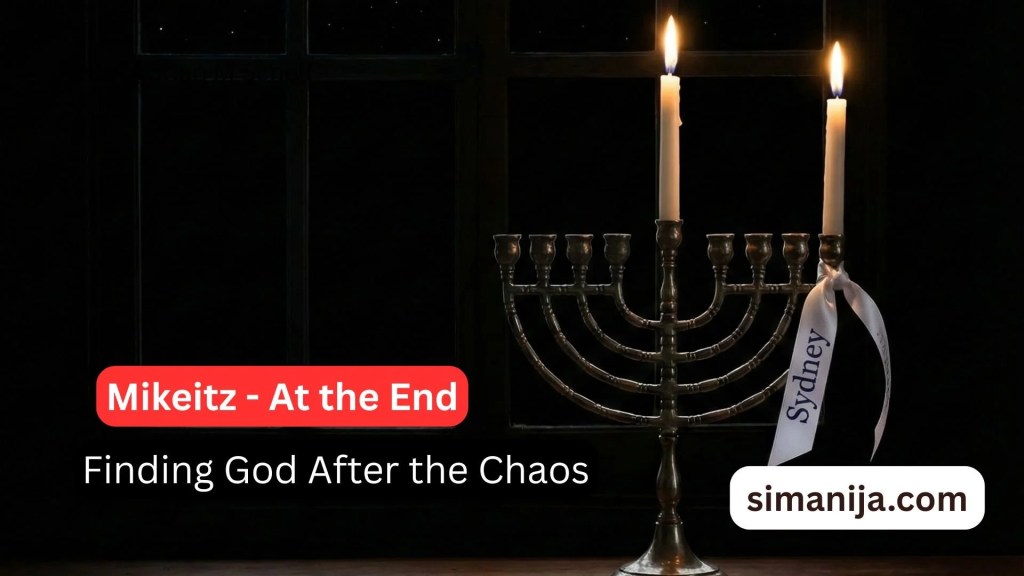
  • At the End: Finding God After the Chaos

    At the End: Finding God After the Chaos

    The Hebrew word that gives this week’s Torah portion its name, Mikeitz, translates simply as ‘at the end’. It refers to the end of two years of Joseph’s imprisonment, marking the precise moment his fortune shifts. In the biblical narrative, the timing is impeccable. Pharaoh dreams, the cupbearer suddenly remembers Joseph, and in a whirlwind of providence, the prisoner is shaved, dressed, and elevated to Vizier of Egypt.

    The text invites us to believe that everything happens for a reason. Looking back at his life later in Genesis, Joseph himself will tell his brothers that it was not they who sent him to Egypt, but God, in order to save lives. It is a theology of a Grand Plan, suggesting that the pit, the slavery, and the false accusations were all necessary distinct plot points in a divine script written for a greater good.

    Yet, this theology is difficult to hold at the end of a week that began with the horrific news of the terror attack in Sydney. When we witness violence tearing through the fabric of ordinary life, the suggestion that such darkness is merely a prelude to a necessary light feels not just hollow, but cruel. We recoil from the idea of a Puppeteer God who moves people like chess pieces, sacrificing innocence for the sake of a future outcome. If this is the plan, we are right to return the ticket.

    Progressive Judaism asks us to read the Joseph story differently. Perhaps God is not the author of the tragedy, but the source of the resilience that follows it. The divinity in Joseph’s story is not found in the fact that he was thrown into a pit; the pit was the result of human cruelty and indifference. God was found in the fact that Joseph did not let the pit become his grave.

    When we look at Sydney, or any place where terror tries to shatter our sense of safety, we must refuse to sanctify the violence as ‘mysterious will’. Instead, we locate the sacred in the response. We see it in the first responders running towards danger. We see it in the strangers shielding one another. We see it in a community that refuses to let hatred have the final word.

    Mikeitz reminds us that we are often standing ‘at the end’ of something we did not choose. We cannot control the chaos that others inflict upon the world. But we are not script-bound actors in a tragedy. We are partners in creation. The challenge of this Shabbat is to reject the paralysis of despair. We do not justify the suffering, but we do determine what comes next.

    May this Shabbat bring comfort to all who are grieving, and may it strengthen our resolve to build a world where safety is not a miracle, but a birthright.

    Shabbat Shalom,

    Rabbi Adrian M. Schell

  • May our light outshine their hatred.

    May our light outshine their hatred.

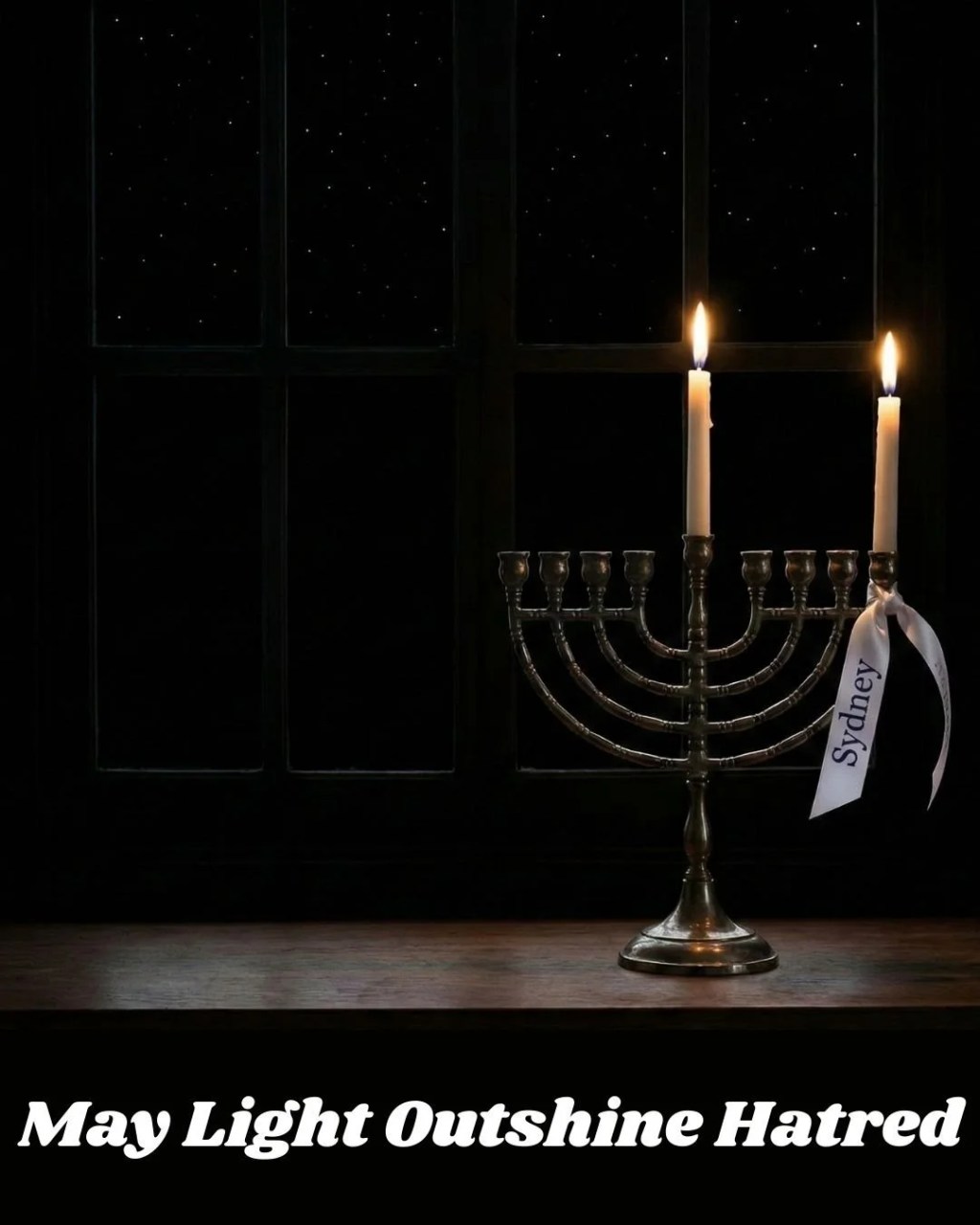
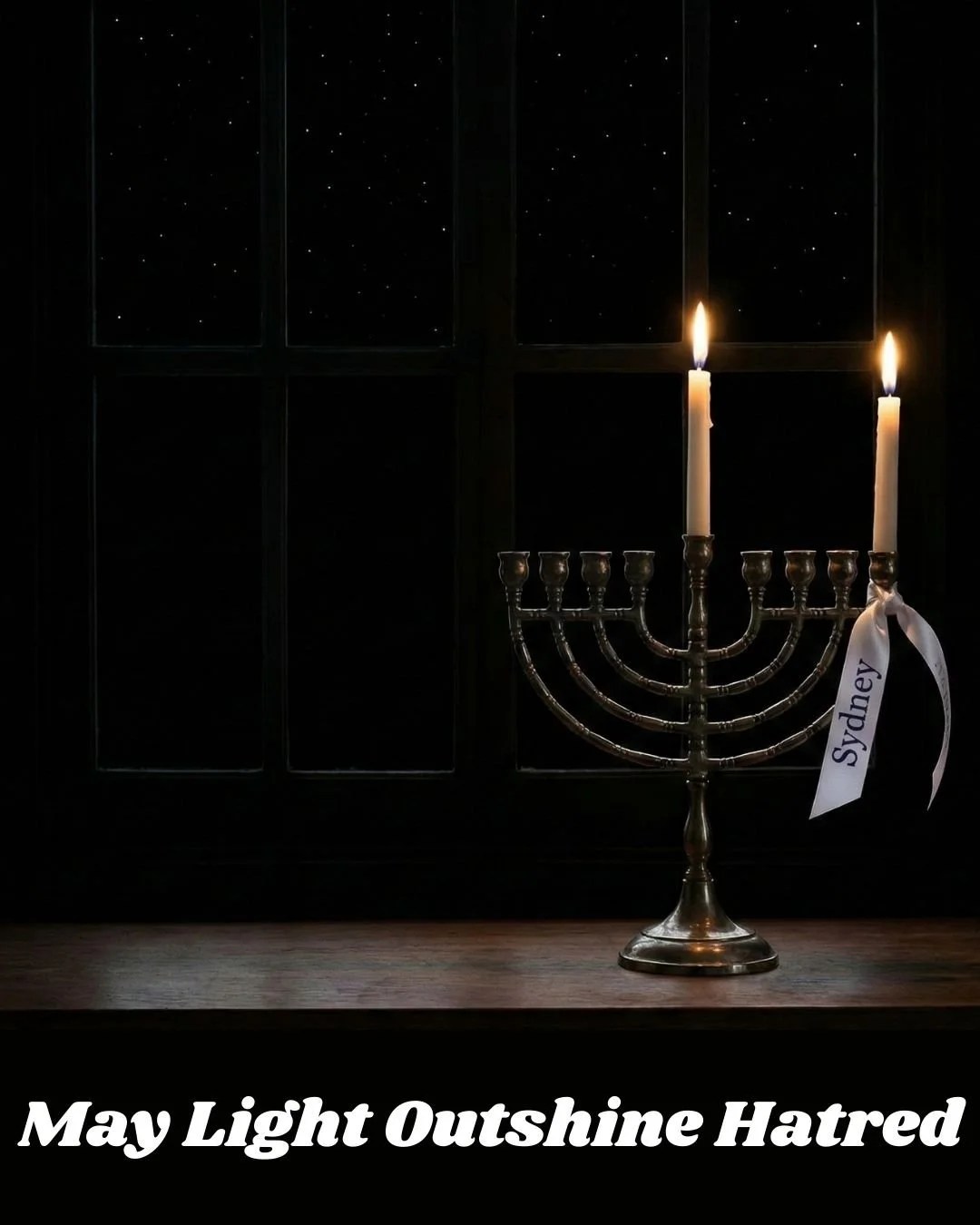
    It seems that all too often in recent years, just as we prepare to kindle the lights of a joyful festival, a shadow is cast over our celebration. The news from Sydney this morning is shocking, heartbreaking, and feels incredibly close to home, despite the distance.

    We grieve with our brothers and sisters across the ocean, mourning the lives taken by baseless hatred, and we pray for Refuah Shleimah for all those suffering in the aftermath of this attack.

    Yet perhaps this is exactly why we need Hanukkah. It is the festival that commands us to bring light into the very darkest time of the year. It also arrives with a vital message of resilience, pride, and the stubborn refusal to despair. We must stand together and not allow those who hate us to push us out of public spaces or force us to hide who we are. We will not retreat. Instead, we will continue to do our part in creating a just and kind world, meeting darkness with light.

    I invite you to light your Hanukkiah tonight with a renewed sense of purpose. Let us light the candles in memory of the victims, but let the flames also serve as a signal to the world that we have not given up on a better future.

    May our light outshine their hatred.

    Hanukkah Sameach

    Rabbi Adrian

  • The Festival of Contradictions

    The Festival of Contradictions

      A great miracle happend there?!
    A great miracle happend there?!

    A Thought for Hanukkah

    Preparing for Hanukkah, I found myself reading a fascinating lecture by the scholar Yehoyada Amir, titled The Contradictory Sides of Hanukkah. It struck me how we often take the story of the Maccabees for granted, yet Amir reminds us that this festival has constantly shifted shape to suit the needs of the Jewish people.

    What I found most thought-provoking was the realisation that for centuries, Hanukkah was actually a rather “shy” and minor domestic moment in our calendar. Amir points out a deafening silence in our early texts; the Mishnah, which is the foundation of Jewish law, has no specific tractate for Hanukkah. It seems the ancient Rabbis were quite uncomfortable with the Hasmonean dynasty and their military history. They hesitated to glorify human warriors or a rebellion that eventually led to corruption.

    Instead, the tradition shifted the focus entirely. The Rabbis introduced the legend of the oil—a story of divine intervention where God saves the helpless. This turned the focus away from the battlefield and towards the miracle of the spirit.

    However, Amir argues that the modern era flipped this narrative once again. The early Zionists sought to reclaim the Maccabees not as religious figures, but as symbols of human agency, national strength, and the “new Jew” who takes history into their own hands. Suddenly, the “shy” festival became a public celebration of sovereignty.

    So, where does that leave us today in Wimbledon? We stand at the intersection of these “contradictory sides”. We have the Rabbinic need for God’s miraculous light in the darkness, and the modern human need to take active responsibility for our destiny.

    Amir also notes that for those of us in the Diaspora, Hanukkah took on yet another role. It became a way to assert our identity and bring our own “light and joy” into the public sphere during a season dominated by Christmas.

    Perhaps the beauty of Hanukkah lies precisely in these tensions. It challenges us to ask whether we are relying on a miracle or relying on ourselves. As we light our hanukkiot this week, may we find space for both the quiet, spiritual gratitude for the oil that lasted, and the active, courageous spirit of the Maccabees who refused to let their light be extinguished.

    Happy Hanukkah

    Rabbi Adrian

    P.S.: Download a your How-To-Hanukkah-Guide here: https://tinyurl.com/WS-Hanukkah

    Amir, Y. (2024) Die widersprüchlichen Seiten von Chanukka: Die Entstehung eines modernen zionistischen Fests und seine Nachwirkungen. Franz-Delitzsch-Vorlesung, Heft 23. Münster: Institutum Judaicum Delitzschianum.

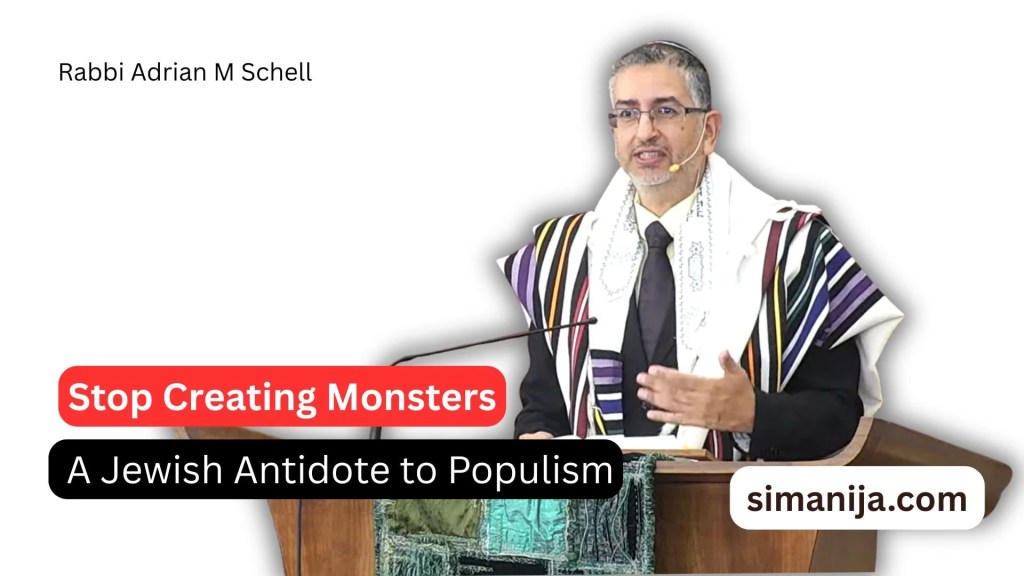
  • Stop Creating Monsters

    Stop Creating Monsters

    A Jewish Antidote to Populism

    Shabbat Vayishlach – Rabbi Adrian M. Schell – 6-12-2025

    May I once again use this opportunity to welcome our esteemed guest, the Secretary of State, Steve Reed. It is a privilege to have you with us in Wimbledon this Shabbat.

    In preparing my sermon for today, many might have thought, or indeed suggested, that I should address some of the pressing logistical issues of our time. I considered speaking to you about housing, about the vital need for security for religious institutions, about strengthening the CST, or about the rising tide of hate crime.

     These are all critical topics, matters of life and safety, and I have indeed thought about all of them and have produced a mental stack of unfinished sermons on each.

    But in my research, I found a quote attributed to you that mirrors so profoundly a key moment of the Torah reading we just listened to that I could not resist expanding on it, for it speaks directly from my heart. I quote you now:

    “People power is the antidote to populism.”

    It is a striking phrase. In the political sphere, it suggests that democracy is reclaimed when ordinary citizens engage, organise, and take ownership of their future. But seen through the lens of our tradition, and specifically through the lens of this week’s Torah portion, Vayishlach, it takes on a deeply spiritual dimension.

    Our portion describes a looming confrontation. Jacob is returning home after twenty years of exile. He is travelling back to the land of his birth, but to get there, he must face Esau, the brother he deceived and betrayed two decades earlier.

    Jacob is terrified. The text tells us he was “greatly afraid and distressed”. He sends spies ahead, and they return with the news that Esau is coming to meet him with four hundred men. In Jacob’s mind, this is an army. He assumes the worst. He assumes war.

    And so, the night before the brothers are due to meet, Jacob finds himself alone on the banks of the Jabbok river. There, in the darkness, a strange event occurs. “And a man wrestled with him until the breaking of the day”.

    Who is this man, this ish? The text is famously ambiguous. Our sages have debated it for centuries. Rashi suggests it was the guardian angel of Esau. Others suggest it was an angel of God. But the Chasidic masters and modern psychologists offer a different, perhaps more challenging interpretation:

    In the dark Jacob wrestles with his his own fear, and with the image of Esau that he has constructed in his mind. For twenty years, silence has stood between the brothers. In that silence, fear has done its work. Distance had sculpted a monster out of a brother.

    This is the mechanism of populism to which your quote alludes. Populism thrives on the abstract “other.” It requires distance. It requires us to construct a caricature of our opponents, stripping them of nuance and humanity until they are no longer people with whom we disagree, but monsters whom we must defeat. When we do not wrestle with these projections, when we do not engage, the other becomes distorted. We fight the ghosts of our own making.

    But then the dawn breaks. The wrestling ends. The sun rises. Jacob looks up and sees Esau in the flesh.

    And in the light of day, the monster vanishes. It was never there. Esau does not attack; he runs to Jacob, he embraces him, he falls on his neck, and they weep together. The monster dissolves in the face of the human reality.

    And this very moment Jacob says something that should be pinned on the wall of every government office in Whitehall and not only there. He looks at this man he has spent twenty years demonising and says:

    כִּ֣י עַל־כֵּ֞ן רָאִ֣יתִי פָנֶ֗יךָ כִּרְאֹ֛ת פְּנֵ֥י אֱלֹהִ֖ים

    “For therefore I have seen your face, like seeing the face of God.” (Gen 33:10)

    This is the Torah’s antidote to the divisive politics of our age. To see the face of the opponent, the stranger, the one we fear, and to recognise in that face the presence of the Divine.

    It is easy to see God in the face of a friend, or a child, or someone who votes the way we do. It is a supreme spiritual challenge to see God in the face of Esau. But Jacob teaches us that we cannot be whole until we can look into the eyes of the other and see their humanity.

    Secretary of State, Steven, this is the challenge for you and your government, too. It is incredibly tempting, when the political winds are blowing a certain way, to let the populists set the agenda. It is politically expedient to adopt the language of the monster-makers, to treat the refugee or the asylum seeker not as a human face, but as a problem to be managed, a statistic to be reduced, or a threat to be repelled.

    But, if “people power is the antidote to populism,” then the government must lead by empowering us to see people, not categories.

     We need you to resist the urge to demonise the vulnerable to satisfy the angry. We need you to dismantle the fear, not manage it.

    The Torah demands we look at the source of real pain, the lack of a home, the lack of safety, the lack of dignity, and treat that, rather than attacking the people suffering from it.

    And for sure not – we do not need to be a community of victims to understand this; we just need to be a community with memory. We know that when a society loses the ability to see the face of God in the stranger, the results are catastrophic. We know that when the agenda is shaped by those who prey on our vulnerabilities, the “other” is erased long before they are physically removed.

    Jacob’s victory was not that he won the fight in the night. It was that he survived the darkness long enough to see his brother’s face in the daylight.

    That is the task before us all.

    To reject the distorted images we are fed. To refuse to let fear design our neighbours. To cross the river, as Jacob did, and look the other in the eye, whether that other is perhaps identifying themselves in a way we haven’t seen them, a neighbour we do not understand, or a refugee seeking safety. And to find the courage to say: I see you. You are not a crisis, you are not a threat to me and our society. You are a human being, created in the image of the Divine.

    It is a decision we make every time we speak, every time we vote, and every time we legislate. We either build monsters, or we recognise the face of God.

    Shabbat Shalom.